Resolving Seed quality Testing in Bika LIMS
Because every other agricultural input, fertiliser, disease prevention and irrigation, depends on seed performance, the seed industry sits at the foundation of the entire food production system and plays a critical role in economic development, rural livelihoods and long-term food security
CapeTown, 21 July 2026, Lemoene Smit

Seed genetics largely determines final crop yield, quality and resilience. Seed are selected and bred for the highest stable yield, resistance to pests, diseases and climate stress, and most efficient use of fertiliser and water
It is not a surprise that the global agricultural seed market is substantial, estimates place its value at approximately USD 70–82 billion in 2025/2026. The market is dominated by hybrid and improved varieties of major field crops, maize, soybean, rice, wheat, cotton and vegetables
For the protection of farmers, the seed industry is one of the most tightly regulated sectors in agriculture. Regulations aim to maintain seed quality, facilitate international trade, and encourage continued innovation. ISTA, the International Seed Testing Association, sets globally accepted methods for testing seed quality: purity, germination, vigour, moisture, etc. Most countries require official certification, labelling, and quality standards before seed can be sold
Seed quality testing is critical to evaluate the overall performance potential of a seed before certification, planting or sale
Purity testing determines the percentage of pure seed versus defects like weed or other crop seeds, inert matter, sprouted and diseased seeds
Germination testing measures the percentage of seeds that successfully sprout under controlled, ideal conditions, providing a direct indicator of viability
Vigour testing goes further by assessing the seed’s ability to produce strong seedlings under stressful conditions, offering a more realistic prediction of field performance
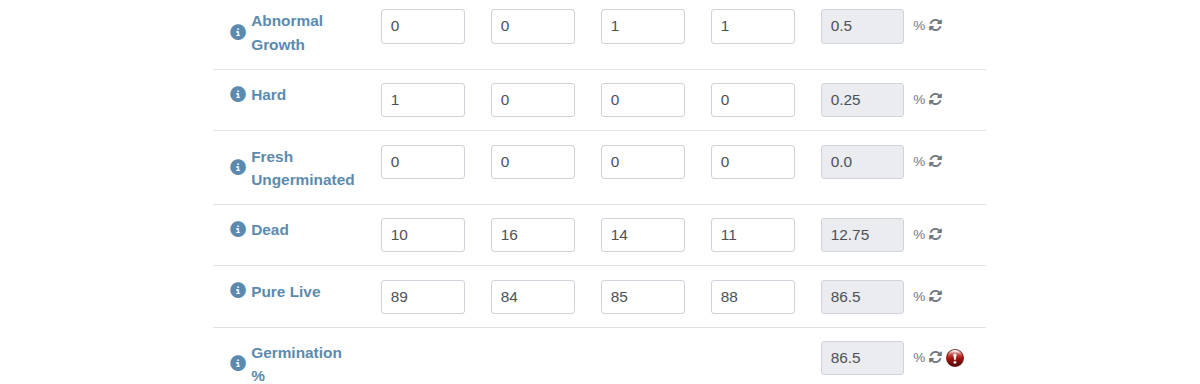
Replicates are used to ensure results are statistically reliable and to detect excessive variation within a sample. For example, in a Germination Test, 400 seeds are divided into 4 replicates of 100 seeds each
Seeds are germinated under controlled conditions on approved substrates and after a prescribed period, normal and abnormal seedlings, hard and dead seeds are counted in each replicate and the average percentage for each parameter calculated
In the LIMS this is resolved with two simple Calculations, averaging counts for each parameter across the 4 replicates, and another to calculate the final germination percentage. Using Calculation Interim fields for the counts:
((100/CountA) + (100/CountB) + (100/CountC) + (100/CountD)) * 100 / 4
We set up the Total count as a variable defaulting it to 100 seeds

The Germination test is then rendered with fields for each count per replicate. When the counts are captured, all the percentages are calculated
The final Germination percentage = 100 - Abnormal% - Hard% - Ungerminated% - Dead%.
That is all there is to it really
We added a few extra Sample attributes too, Type, Variety, Production Year, Inspectorate and Lot numbers. If the testing for farmers delivering seeds, they can track the origin of each lot by using their fields as Sample Points. As lab Clients they get copies of their seeds’ results too